
Escoba
- 2–4 Players
A Spanish classic played with Spanish cards. Add up to 15 and sweep the table clean. Play it free with friends, or against opponents who play like people.
Escoba rules
Goal
Capture cards by making totals of 15. Score for sweeps and valuable captures over several deals. The target is 21 points, with the winner decided after a complete deal is scored.
The cards
Escoba uses a 40-card Spanish deck. Its suits are oros (coins), copas (cups), espadas (swords) and bastos (clubs). Each suit has cards from 1 to 7 and three court cards. Number cards use their face value; the sota counts as 8, the caballo as 9, and the rey as 10.
The deal
Two, three or four players each play for themselves. The dealer gives everyone three cards and places four face up on the table. If those four total 15, the dealer takes them for one escoba; if they total 30, for two. The other seats are filled by computer opponents.
When everyone's hand is empty, each player receives three more cards from the stock. Repeat until all cards have been played, then score the deal. The next player to the dealer's left deals again.
Playing
The player to the dealer's left starts, and turns continue to the left. Play one card from your hand. If it totals exactly 15 with one or more table cards, capture that combination, including your played card. A card with no possible capture stays face up on the table.
You may choose which hand card to play, but a card that can capture must do so. If it can make several different combinations totalling 15, choose one combination to take.
Select your hand card and the table cards you want to take, then press Capture when they total 15. To leave a card on the table, select it alone and press Discard. You can also drag your card onto the table to play it with the selected table cards.
Escobas
A capture that clears the table is an escoba, worth 1 point, even on the last play of a deal. After all cards have been played, the last player to capture also receives any leftovers. Collecting leftovers is not an escoba.
Scoring
After each deal, award 1 point for most cards, 1 for most oros, 1 for most sevens, and 1 for the 7 of oros. Each escoba adds 1 point. A tie for the highest number of cards, oros or sevens awards nobody that category's point.
All ten oros score 2 points instead of 1. All four sevens add a bonus point, for a total of 3: most sevens, all sevens, and the 7 of oros.
Winning
Scores carry over between deals. Once a completed deal leaves at least one player at 21 or more, the highest total wins. If the highest total is tied, play another deal until one player leads.

How to win at Escoba
Meet Paco
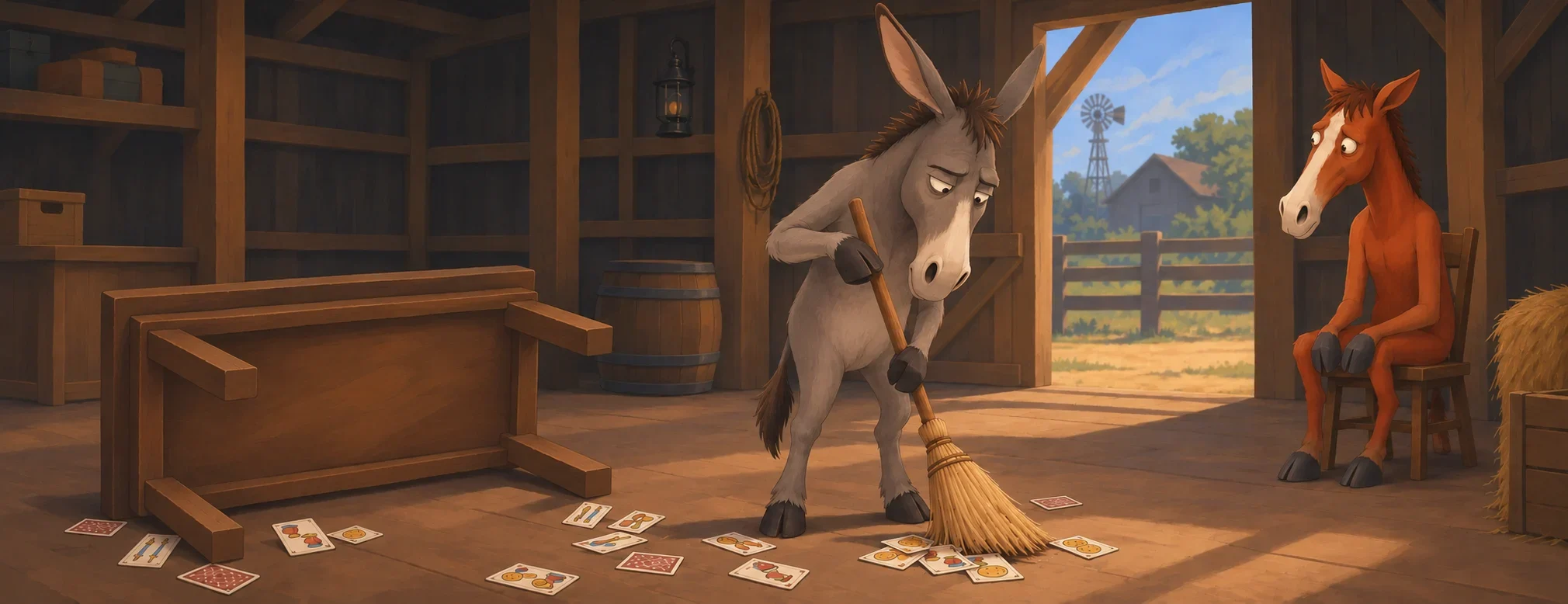
Plays Escoba at Expert levelEscoba · Expert levelPaco watches the table through half-closed eyes. Patient and hard to rattle, he knows Escoba well and takes a little too long to admit when his usual approach needs changing.
Paco tells you how to beat Paco.
Take the 7 of oros
That seven earns a point on its own and counts towards most oros and most sevens too. It is the card I least like leaving on the table for someone else.
Add up what you leave behind
A table totalling 7 can be swept by a sota, worth 8. Any total from 5 to 14 leaves a possible sweep. Aim to leave 4 or less, or 15 or more, when choosing a card to lay down.
Choose the capture that helps your score
A sota can take a 7 or a 3 and 4. If that seven is the 7 of oros, it brings its own point. The two-card capture helps your card count. See which points you still need before choosing.
Keep sevens and oros off the table
If you have to leave a card, choose a card from copas, espadas or bastos when it also leaves a safe total. Save sevens and oros for captures, where they go into your pile instead of waiting for the next player.
Keep collecting after the majority is yours
Three sevens secure most sevens; six oros secure most oros. All four sevens and all ten oros each earn another bonus point. The last few can still be worth chasing.
Look for a final capture
Whoever captures last receives the cards left on the table. In the final round, look for a capture you can save for your last turn. Those leftovers count towards cards, oros and sevens.
Questions about Escoba
What does escoba mean?
Escoba means broom in Spanish. A capture that clears the table is called an escoba, or sweep, and scores a point. The game is also called Escoba de 15 because your played card and the cards you capture must total 15.
What are the court cards worth?
The sota is worth 8, the caballo 9, and the rey 10. Number cards from 1 to 7 use their face value. For example, a rey captures a 5, while a sota can capture a 7 or a 4 and a 3 together.
Why does the deck have only 40 cards?
This version uses the 40-card Spanish deck. Each suit has seven number cards, from 1 to 7, and three court cards: sota, caballo and rey. The four suits are oros (coins), copas (cups), espadas (swords) and bastos (clubs).
Do I have to capture when I can?
You may choose any card from your hand. Once you choose a card that can capture, it must make a capture; you cannot simply leave it on the table. You may play a different card that has no possible capture instead.
Can I capture more than one group with a card?
Your played card can capture several table cards, but they must form one combination totalling exactly 15 with it. You cannot use the same played card to make two separate fifteens. If several combinations are possible, select the table cards you want and your hand card, then press Capture.
How much is an escoba worth?
Each escoba scores 1 point. There is also an opening bonus: if the four cards dealt to the table total 15, the dealer takes them for one escoba. If they total 30, the dealer takes them for two escobas. A normal capture that clears the table with the last card of the deal also counts.
What happens to the cards left on the table at the end?
The last player who made a capture receives them. They count toward that player's totals for cards, oros and sevens, and can include the 7 of oros. Collecting these leftovers does not count as an escoba.
How is a deal scored?
You score 1 point for each escoba, 1 for most cards, 1 for most oros, 1 for most sevens, and 1 for the 7 of oros. Taking all ten oros adds 1 extra point. Taking all four sevens also adds 1 extra point, giving 3 in total for most sevens, all sevens and the 7 of oros. A tied category awards no majority point.
Why is the 7 of oros so important?
It earns 1 point by itself and contributes to your totals for oros and sevens. Capturing it can therefore help you win several scoring categories, even if the capture takes only a few cards.
What if two players tie for most cards?
Nobody receives the point for most cards if the highest count is tied. The same rule applies to ties for most oros or most sevens. Other points, such as escobas and the 7 of oros, are still scored normally.
How many points do I need to win Escoba?
The target is 21 points, checked after a complete deal is scored. If at least one player has reached 21, the player with the highest total wins. A tie for the highest total means another deal is played.
Do four players play in teams?
No. In this version, two, three or four players each play for themselves. Each player's captures and points are counted separately.
Is Escoba the same as Scopa?
They are related capture games with different capture totals. In Scopa, your played card matches the value of the table cards you take. In Escoba, your card and the captured cards together must total 15.
Can I play Escoba against the computer for free?
Yes. Opening this page starts a free match against three computer opponents, with no account or download required. Open New game to choose two, three or four players and the characters in the other seats.


