
How to play Forty Thieves Solitaire
1 player

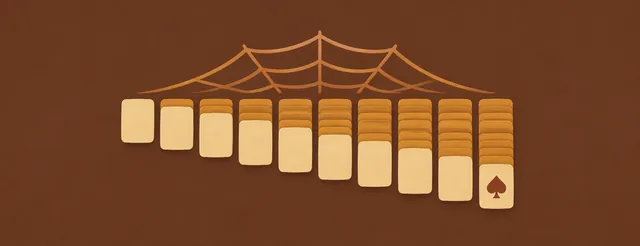
Forty Thieves looks like a crowd at first: two full decks, and forty cards laid out face up in ten columns before you’ve made a single move. You can see every one of them, which is a kindness and a warning at the same time. Your job is to sort all 104 cards into eight piles, one for each suit of each deck, from ace up to king.
You move one card at a time, and only a card nothing is lying on. It can go onto its pile, or onto a card one higher of the same suit, so the 6 can go on the 7. When a column is cleared, any card can go into the space, and I’d think twice about what you put there. The other 64 cards wait face down; you turn them over one by one, and you only go through them once.
When every card has reached its pile, you’ve won. Most games don’t get that far, and even careful players win only about one in ten. That’s the pleasure of it, I think: nothing on the table is hidden from you, so every win is one you worked out for yourself.
How a game works
Again and again
Move a card
Put one card on a card one higher of the same suit, or into an empty column.
Turn a card
Out of moves? Tap the stock to turn its next card face up. You go through it once.
To win
Build the foundations
Cards go up in suit from ace to king. Fill all eight foundations and you win.
Finish a game with Voicu
RulesRules
Moving, turning and winning
- The deal
- Two decks, 104 cards. Forty are dealt face up in ten columns of four; the other 64 are the stock.
- Building down in suit
- 10
 9
- A card goes on a card one higher of the same suit, like the 9 of spades on the 10 of spades.
- One card at a time
- Only the top card of a column or of the waste moves, and only by itself. A run in order is taken apart card by card.
- Empty columns
- An empty column takes any card. It’s the only way to move a card that has nowhere else to go.
- The stock
- Tap it to turn its next card face up onto the waste. Once it’s empty it stays empty: there’s no second pass.
- Foundations
- A23
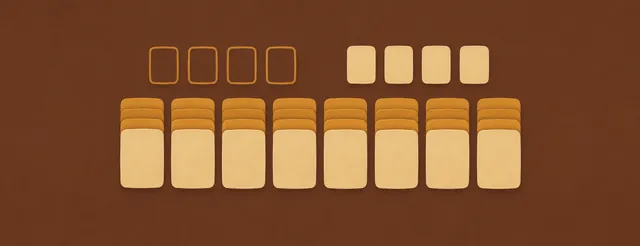
- Eight of them, two for each suit, built from ace to king. A card on a foundation stays there. Aces, and cards no column can still use, go up by themselves.
- Tap or drag
- Tap a card and it goes where it fits: its foundation first, then a card one higher of its suit, then an empty column. Drag it to choose yourself.
- Moves and Undo
- There’s no score. The table counts your moves and stock turns, and Undo takes back the last one. No moves left means the stock is empty and nothing can move.
Napoleon’s game
Forty Thieves belongs to the family of patience games played with two decks, the big, slow ones that need a whole table. It is a game of skill more than luck: every card in the columns is face up from the start, so you can plan as far ahead as you like. Its name counts the forty cards dealt at the start, and in Britain it was long called Napoleon at St Helena, after the story that the emperor passed his exile playing it.
It has a reputation as one of the hard solitaires, and its players like it that way. They swap tips about keeping a column empty and argue over whether a deal could have been won. It turns up in nearly every big solitaire collection on computers and phones, and it has lasted because winning one feels earned: one card at a time, one pass through the stock, and no luck to blame.
Ready to play Forty Thieves Solitaire?
The cards are dealt. Your game starts right away.