
How to play Pyramid Solitaire
1 player

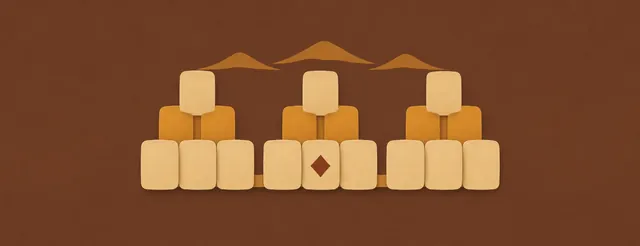
Pyramid Solitaire is a little puzzle in the shape of a pyramid. You play it on your own. Twenty-eight cards are laid out face up, with one card at the very top and seven along the bottom. Your job is to clear the whole pyramid away until not one of its cards is left on the table.
Every card is worth its number, and an ace counts as 1, a jack as 11 and a queen as 12. Two cards leave the table together when they add up to 13, like the 6 and the 7
 , and a king is worth 13 all by itself, so it leaves alone. You can only use a card that has nothing lying on it. When you can’t find a match, you turn up a new card from the spare cards beside the pyramid.
You win the moment the last card of the pyramid is gone. There are no points to count and no clock to beat. The hard part is choosing, because the card that fits now may be the very one you need later. Not every game can be won, so the ones you do win feel properly earned.
How a game works
Again and again
Pair up cards
Two free cards that add up to 13 leave together, and the cards under them come free.
Turn up a card
No pair? Tap the stock. The card that lands on the waste can pair with the pyramid.
To win
Clear the pyramid
When the last pyramid card is gone, you win. If no card can ever leave, the game is over.
Clear a pyramid with Voicu
RulesRules
What adds up to 13
| Cards | Worth | Total |
|---|---|---|
Ace and queen | A  Q1 + 12 | 13 |
2 and jack | 2 J 2 + 11 | 13 |
3 and 10 | 3 103 + 10 | 13 |
4 and 9 | 4 94 + 9 | 13 |
5 and 8 | 5 85 + 8 | 13 |
6 and 7 | 6 76 + 7 | 13 |
King | K Leaves alone | 13 |
Playing and winning
- Free cards
- A pyramid card is free when no card lies on it. The top card of the waste is free too.
- A card and the card under it
- 94
- A free card may pair with a card it covers, if it is the only card still lying on it. The waste’s top card can’t do this.
- The stock
- It holds the 24 cards left after the deal. Tap it to turn one card onto the waste. A card still in the stock can’t be paired.
- Turning the waste over
- When the stock is empty, tap its place to put the waste back in the same order, as often as you like.
- Winning
- Clear all 28 pyramid cards. Cards left in the stock or on the waste don’t matter.
- No more moves
- The game ends when no pyramid card can ever be removed, and the table shows how many are left.
- Tap or drag
- Tap one card and then its partner, or drag one onto the other. A free king goes with one tap.
- Moves and Undo
- There is no score and no clock. The table counts every draw, turnover and removal, and Undo takes back the last one.
Twenty-eight cards and an unlucky number
Pyramid belongs to the adding-up family of patience games, the card games you play alone, where cards leave the table because of what they total. Its relatives chase other numbers, like the 14 of Fourteen Out. The grand name comes from the shape on the table rather than from ancient Egypt, though that hasn’t stopped anyone dressing it up: one early computer version was called Tut’s Tomb.
Pyramid once had a fearsome reputation. Old card books guessed you would win one game in fifty, and one magazine called it next to impossible. Those rules allowed one trip through the spare cards. Let them come round as often as you like, as they do here, and a study of 100 million deals found about five in six can be won. Today it sits beside Klondike, Spider and FreeCell on computers and phones, a favourite for a quick puzzle.
Ready to play Pyramid Solitaire?
The cards are dealt. Your game starts right away.