
How to play Yukon Solitaire
1 player

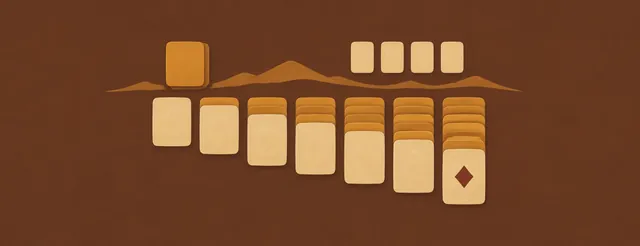
Yukon looks almost exactly like Klondike, and I was fooled by that for years. You play it alone with one deck of 52 cards, and every card is dealt at the very start, into seven columns, with a good many face down at the bottom. Your job is to sort the whole deck into four piles, one for each suit, in order from the ace up to the king.
A card can go on another card that is one higher and the opposite colour, so the 6 can go on the 7
 . What surprised me is that any face-up card can move, even one from the middle of a column, and every card lying on top of it comes along, whatever order they’re in. Only a king can go into an empty column. There is no spare pile to turn to, so everything you need is already somewhere on the table.
When all 52 cards are in their four piles, you’ve won. There are no points and no clock. Most deals can be won if you’re careful about which cards you bury, and I find that freeing a column full of hidden cards in one move is about as satisfying as solitaire gets.
How a game works
Again and again
Move cards
Put a card on a card one higher of the other colour. Whatever lies on top of it goes too, and a hidden card turns over once it’s uncovered.
To win
Build the piles
Cards go up to their suit’s pile, from the ace to the king. Cards nothing else needs go up by themselves.
Win a game with Voicu
RulesRules
Moving, building and winning
- The deal
- Every card is dealt at the start into seven columns of 1, 6, 7, 8, 9, 10 and 11 cards. The top five of each column are face up; the rest, 21 in all, are face down. There is no stock.
- Building down
- 76
- A card goes onto a card one rank higher of the other colour. Nothing goes onto an ace.
- Carrying cards
- 6J
 2

- Any face-up card can move, and every card on top of it goes too, in whatever order they lie.
- Empty columns
- K
- An empty column takes only a king, along with any cards on top of it.
- Hidden cards
- A face-down card turns over by itself once nothing covers it.
- The four piles
- A23
- Each suit is built up from the ace to the king. A pile’s top card can come back down onto a column where it fits.
- Cards that go up by themselves
- Aces, twos and any card no column can still use go up by themselves. Once every card is face up and in order, the rest follow.
- No moves left
- When nothing useful can move, the table says No moves left. Undo and New game still work.
- Russian Solitaire
- Chosen in New game. Everything is the same, except that a card goes onto the card one higher in its own suit. It is much harder.
- Tap or drag
- Tap a card and it goes where it fits, or drag it there yourself. Undo takes back your last move.
- Moves
- There is no score or timer. The table counts your moves, not the cards it moves by itself.
Klondike’s bolder cousin
Yukon belongs to patience, the big family of card games people play alone. It is a close cousin of Klondike, the game most people call Solitaire, and both are named after the far north of Canada, where the gold rush drew prospectors at the end of the 1800s. Yukon keeps Klondike’s seven columns and four piles but throws away the spare pile, so the whole deck is on the table from the first move.
Its freedom to move any face-up card, tidy or not, gave it a whole family of its own: Russian Solitaire builds in one suit and is far harder, Alaska lets cards build up or down, and Scorpion borrowed the same untidy moves. Yukon has lasted because it rewards thinking ahead. Most deals can be won, yet one careless move can bury the card you need under a tall stack.
Ready to play Yukon Solitaire?
The cards are dealt. Your game starts right away.